
Automation for Norway's largest AutoPASS issuer.
Seven automation processes that keep the customer data and billing of a high-volume toll operation correct. We designed them, built them, documented them, and still maintain them.
The company
AutoSync AS, Oslo
AutoSync is Norway's largest AutoPASS issuer: more than 1.4 million customers, more than 1.9 million active vehicles and over 600 million toll passages invoiced a year. It holds the customer contracts and does the billing; the toll stations themselves are run by the road operators.
Its 36 people send more than 7.5 million invoices a year, around 20,000 a day, on a margin the regulator sets at 1.75%. That makes it a financial-services business as much as a transport one. Every passage becomes an invoice, every invoice follows an address, and every address belongs to a person or company whose details change. With a margin that thin, the exceptions, not the volume, decide the cost.
What we built
Seven processes, each designed, built and documented module by module.
Agreement approvalNew agreements checked and approved
Runs continuously. Incoming forms are processed as a stage inside this workflow, so a new agreement goes from form to approval without waiting in a queue.
Invoice handlingInvoice calculation and follow-up
Runs continuously, covering invoice calculation and the steps that follow it. Software robots take the simple invoices and people handle the complex ones.
Case closingResolved cases closed without manual steps
Runs continuously, so agents stop spending time on cases that are already resolved.
Customer record reconciliationStale details corrected against the national register
Finds customers whose address or contact details went out of date when they moved or sold a property, and corrects them against the national population register. When every other identifier has decayed, the number plate is the key.
Old tag terminationExpired toll tags replaced, customer told why
Norwegian rules tie each toll tag to one vehicle, so a stale tag cannot simply be deleted. The process ends the old tag, sends a replacement and emails the customer a short explanation.
Øresund integrationA crossing outside the domestic toll system
A separate workflow for one crossing that sits outside the domestic toll system, run on request.
Self-service vehicle editsCustomer changes to vehicles applied
Applies the changes customers make to their registered vehicles.
How we worked
Robotic process automation in production
The processes run in UiPath. Each one started as a written design: what triggers it, which systems it reads and writes, and what happens when a step fails. Every module has its own documentation, so AutoSync's team can see what each part does without asking us.
Data corrected against the source of truth
Customer details are checked against Norway's public registers, the population register for people and the vehicle register for vehicles, and corrected where the register disagrees. AutoSync's own customer terms say it may do exactly this.
Inside AutoSync's environment
Every system and all data stay on AutoSync's own servers in Norway. We work through remote sessions on virtual machines inside that environment, with accounts AutoSync controls.
AI across the business processes
Since 2024 we have added multi-agent AI orchestration across the business processes.
Where it started: customer service
We started in 2018 with Fjellinjen, which held the issuer role at the time, and built its customer-support chatbot. When Norwegian toll reform required the issuer business to be separated from the road operators, it was carved out, then acquired by Fremtind, and renamed twice before becoming AutoSync. The team and the product carried through every step, and so did we.
The chatbot ran on one vendor's platform (Bold360) and the live agents on a competitor's (Genesys), so we built the handover between them: when a chat moves to a person, the agent sees the whole bot conversation. We also built the first robots that handle customer email.
Genesys's published story about this customer service, from when the company was named Fremtind Service, reports that more than half of chat enquiries are solved automatically and that email replies fell from five days to 24 hours. Those are Genesys's figures, for the whole service, not ours alone.
Where it stands
All seven processes are built. The core ones run continuously; the rest run on request or wait for the next time they are needed.
The design and build work is done. What remains is maintenance and small changes, which we still handle.
Also our work: our own back office
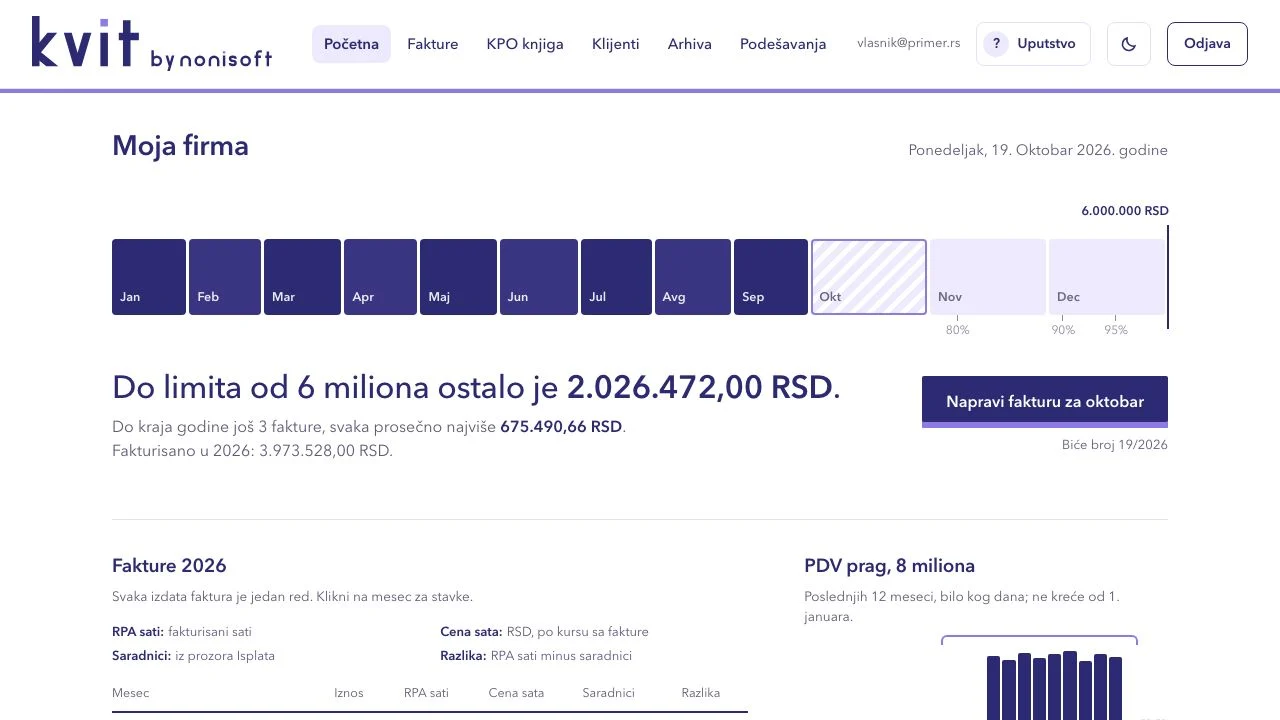
Kvit joins our invoices, client reports, email, tax documents, reminders and a twelve-year archive into one system, with issued records locked by the database.
Tell us which process takes too long.
Describe the process and where it hurts. An engineer who would work on it replies within one business day with questions, not a sales deck.
Email office@noni-soft.com